The volume of data being produced globally is soaring, and organizations are under increasing pressure to adopt analytics platforms that can handle both scale and speed. According to Forbes, 120 zettabytes of data are stored worldwide, and this is projected to grow to 180 zettabytes by the end of 2025. This tremendous growth is driving businesses to seek platforms that support not only high-throughput batch analytics but also real-time processing.
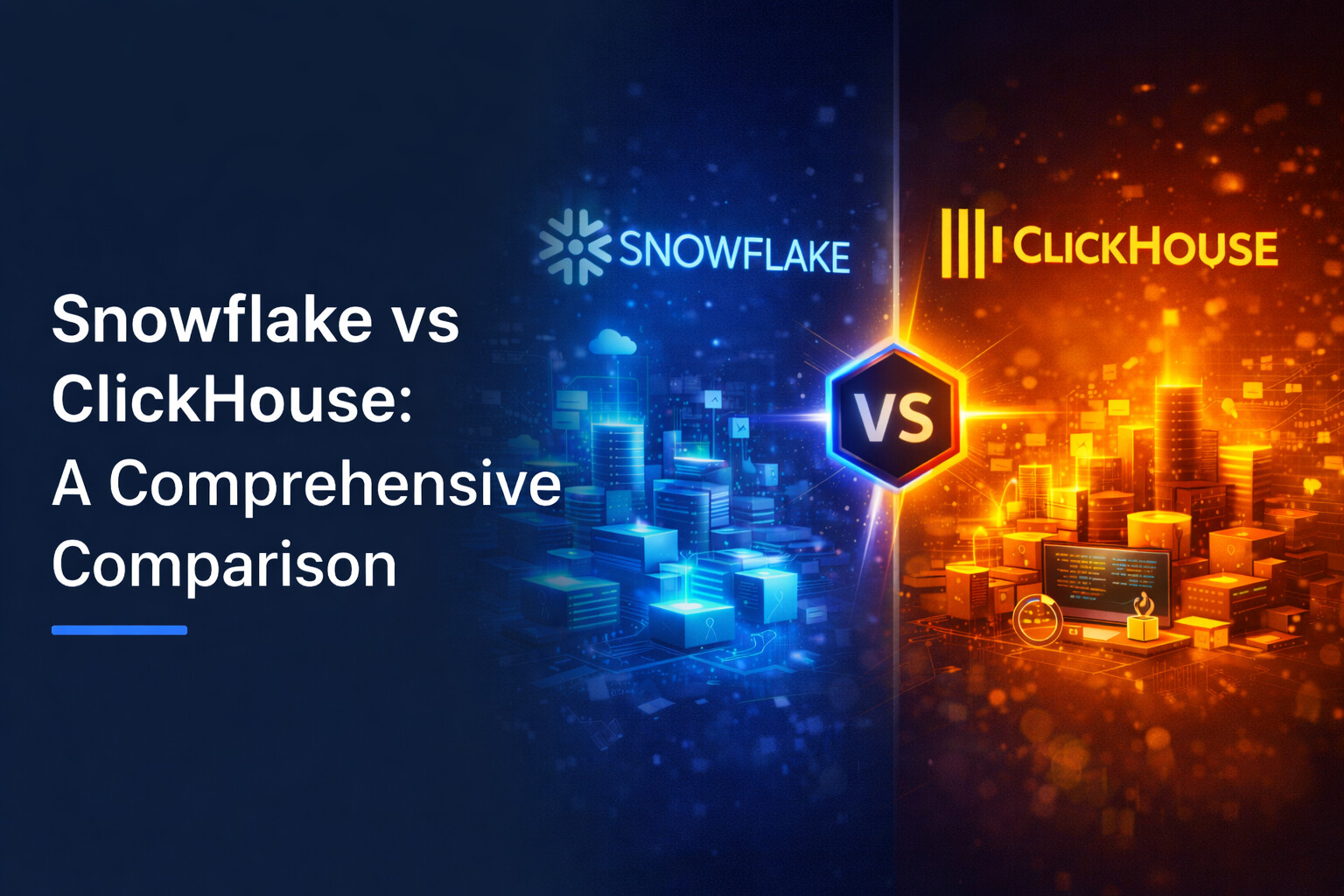
In this context, Snowflake and ClickHouse stand out as two of the most powerful and complementary solutions. Snowflake offers a fully managed, cloud-native data warehouse that emphasizes governance, elasticity, and ease of use. ClickHouse, on the other hand, is built for ultra-fast, real-time analytical queries with a focus on performance.
In this blog, we’ll compare Snowflake and ClickHouse across various parameters so that you can choose the best fit for your data strategy.
Comparison Points: Snowflake vs Clickhouse
Below are the major Snowflake vs ClickHouse comparison points, highlighting their core differences:
1. Architectural Foundations
Snowflake
- Snowflake is a fully managed, cloud-native data warehouse built on a multi-cluster shared-data architecture. It separates storage, compute, and cloud services, allowing users to scale each independently. This makes it ideal for enterprises that want simplicity and elasticity without managing infrastructure.
ClickHouse
- ClickHouse is a high-performance, open-source columnar OLAP database designed to process billions of rows per second. It uses a shared-nothing architecture and focuses on read-intensive, real-time analytical workloads. It requires more hands-on setup but delivers extreme speed.
2. Performance Comparison
Snowflake
Snowflake offers strong performance for complex analytical queries, semi-structured data, and large batch workloads. Using result caching and automatic optimization, it delivers consistent performance across different use cases.
ClickHouse
ClickHouse is engineered for speed at scale and regularly outperforms other systems in benchmark tests for real-time analytics. It excels at log analytics, time-series queries, and high-volume event processing with millisecond-level latency.
3. Scalability & Elasticity
Snowflake
Snowflake offers near-infinite scalability with auto-scaling and auto-suspend features. Compute clusters scale up or down automatically, ensuring pay-as-you-use efficiency.
ClickHouse
ClickHouse scales horizontally using sharding and replication. While extremely scalable, managing clusters requires more technical expertise. Cloud-managed ClickHouse services simplify this, but still demand more tuning than Snowflake.
4. Ease of Use & Management
Snowflake
Snowflake is widely praised for its ease of use, automated maintenance, automatic tuning, and zero-management operations. This simplicity is one reason enterprises rely on Snowflake consulting and support services to accelerate cloud adoption.
ClickHouse
ClickHouse offers flexibility but requires manual configuration, indexing, partitioning, and hardware optimization. This favors teams with strong in-house database engineering experience.
5. Cost & Pricing Model
Snowflake
Snowflake uses a consumption-based pricing model; compute and storage are billed separately. Costs can scale up quickly without governance, but can also be optimized using warehouse auto-suspend and resource monitors.
ClickHouse
ClickHouse is open source, making it highly cost-efficient for teams capable of self-hosting. Cloud-managed versions are available, but still typically cheaper than Snowflake for high-ingestion workloads.
6. Ideal Use Cases
Snowflake
Best for:
- Enterprise data warehousing
- BI reporting and dashboards
- Data governance and compliance-heavy use cases
- ELT/ETL pipeline
- Multi-cloud strategy
It is especially beneficial when paired with Snowflake consulting and support services for optimized deployment.
ClickHouse
Best for:
- High-speed log analytics
- Observability platforms
- Monitoring systems
- Clickstream analysis
- Real-time dashboards
Organizations often use ClickHouse support service to handle scaling and cluster management.
7. Integration Ecosystem
Snowflake
Snowflake integrates seamlessly with most major BI tools, ETL platforms, ML frameworks, and cloud ecosystems (AWS, GCP, Azure). Its marketplace and data sharing features are industry-leading.
ClickHouse
ClickHouse integrates well with OLAP tools, observability systems, streaming platforms (Kafka), and data lake architectures. It supports native connectors but has a smaller ecosystem than Snowflake.
Also Read – Why Snowflake is Popular for Cloud Data Work
Tabular Comparison of Snowflake vs. ClickHouse
| Point | Snowflake | ClickHouse |
| Architecture | Managed cloud data warehouse; storage & compute separated. | Open-source columnar OLAP DB; shared-nothing architecture. |
| Performance | Great for complex, batch, and semi-structured analytics. | Ultra-fast for real-time queries and high-volume events. |
| Scalability | Auto-scaling with minimal setup. | Horizontal scaling via sharding; more manual tuning. |
| Ease of Use | Effortless; zero infrastructure management. | Requires configuration & engineering effort. |
| Cost Model | Consumption-based (compute + storage billed separately). | Open-source; cheaper for heavy ingestion. |
| Best Use Cases | Enterprise warehousing, BI, governed data. | Log analytics, time-series, clickstream, and real-time dashboards. |
| Integrations | Strong BI/ETL/ML ecosystem across all clouds. | Good for OLAP + streaming tools; smaller ecosystem. |
Conclusion
Both Snowflake and ClickHouse are powerful, but they serve fundamentally different analytics needs. Snowflake is the go-to platform for enterprise-scale warehousing, governed data models, and ease of management. ClickHouse is the right choice when ultra-fast, real-time analytics at scale is the priority.
Your choice depends on whether you value managed simplicity (Snowflake) or raw performance and control (ClickHouse).
FAQs
1. Does ClickHouse support ACID transactions like Snowflake?
ClickHouse provides limited transactional support mainly for inserts, while Snowflake offers stronger consistency and transactional guarantees suitable for enterprise-grade data warehousing.
2. Can Snowflake handle real-time data?
Yes, with features like Snowpipe, but ClickHouse is typically better suited for true real-time workloads.
3. Is ClickHouse enterprise-ready?
Yes, especially ClickHouse Cloud, though it still requires more tuning compared to Snowflake.
4. Which platform is more cost-efficient?
ClickHouse is generally cheaper for large ingestion workloads. Snowflake is more cost-efficient when you prioritize maintenance-free operations.
5. Can Snowflake and ClickHouse be used together?
Absolutely. Many companies use ClickHouse for real-time analytics and Snowflake for long-term storage and BI reporting.
About the Author