Hybrid data architectures have become the default reality for modern enterprises. Few organizations operate entirely on the cloud or entirely on-premise anymore. Instead, data lives across legacy systems, private infrastructure, and multiple cloud platforms often simultaneously. In this mixed environment, companies are re-evaluating their data foundations and asking a critical question: does Hadoop still matter?
The short answer is yes. Far from being outdated, Hadoop continues to play a central role in hybrid big data architecture, especially for organizations managing high-volume, regulated, or cost-sensitive data workloads. When implemented correctly, Hadoop remains one of the most reliable engines for large-scale data processing across hybrid environments.
Understanding Hadoop’s Role in Hybrid Data Architectures
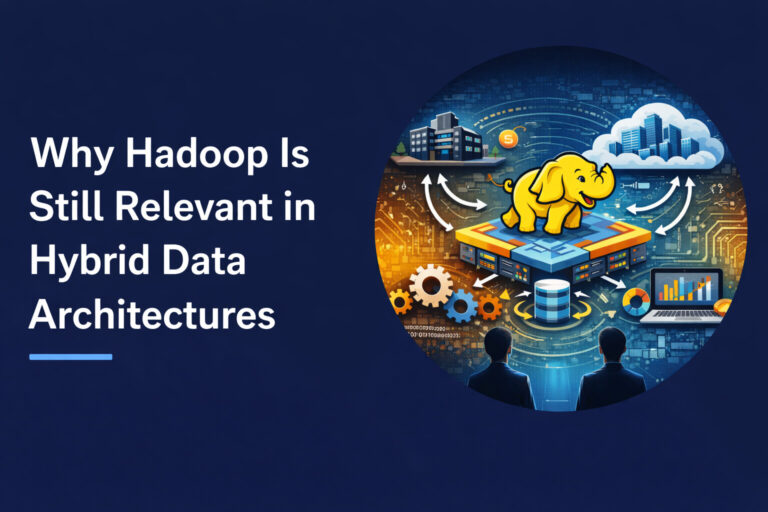
A Hadoop hybrid data architecture combines on-premise Hadoop clusters with cloud-based analytics, storage, or processing services. This model allows enterprises to balance control, scalability, compliance, and cost.
Hadoop’s design principles distributed storage, fault tolerance, and parallel processing make it naturally suited for hybrid deployments. While cloud platforms excel at elasticity, Hadoop provides consistency and governance where long-term data management is required.
This is why Hadoop hasn’t disappeared. Instead, it has adapted.
Why Hadoop Is Still Relevant in Hybrid Data Architectures
1. Cost Control for Large-Scale Data Processing
Cloud-native analytics tools often work well for burst workloads but become expensive when handling persistent, high-volume data. Hadoop allows enterprises to keep large datasets on-premise while selectively leveraging cloud resources for analytics or compute-heavy tasks.
This balance is one of the most overlooked benefits of Hadoop in hybrid cloud environments. Instead of moving petabytes of data into the cloud, businesses process data where it makes the most financial sense.
Example:
A telecom provider stores historical call detail records on an on-premise Hadoop cluster while using cloud-based BI tools for real-time reporting reducing cloud storage costs without sacrificing analytics speed.
2. Data Gravity and Latency Advantages
Data gravity remains a real constraint. Moving large datasets between environments introduces latency, security risks, and operational overhead. Hadoop minimizes unnecessary data movement by processing data locally while integrating selectively with cloud services.
This makes Hadoop in hybrid data architectures especially valuable for industries like banking, healthcare, and manufacturing, where data locality is critical.
3. Strong Governance and Compliance Capabilities
Hadoop ecosystems support granular access controls, encryption, and auditing capabilities that are harder to standardize across multiple cloud services. For regulated enterprises, Hadoop becomes the governance anchor in a hybrid setup.
This is one of the key ways How Apache Hadoop Drives Business outcomes beyond raw performance. It allows enterprises to modernize analytics without compromising compliance.
4. Seamless Integration with Modern Analytics Tools
Modern Hadoop distributions integrate smoothly with:
- Cloud object storage
- Streaming platforms
- AI and machine learning frameworks
- SQL-based analytics engines
This integration capability supports Hadoop hybrid architecture use cases where legacy data must coexist with modern analytics pipelines.
Hadoop is no longer a closed ecosystem-it’s a flexible data backbone.
Also Read – How Hadoop Compares to Modern Cloud Warehouses
Hadoop Hybrid Architecture Use Cases That Still Dominate
Use Case 1: Enterprise Data Lakes
Many enterprises maintain Hadoop-based data lakes on-premise while extending analytics to the cloud. This hybrid approach avoids full migration risks and allows gradual modernization.
Use Case 2: Batch + Real-Time Analytics
Hadoop handles large batch workloads efficiently, while cloud-native tools manage real-time insights. Together, they form a resilient hybrid analytics stack.
Use Case 3: Data Archival and Historical Analysis
Hadoop remains one of the most cost-effective platforms for storing and analyzing historical data over long periods a use case cloud platforms struggle to match economically.
Hadoop vs Cloud-Only Architectures: A Practical Comparison
| Factor | Hadoop Hybrid Architecture | Cloud-Only Architecture |
| Cost control | High for large datasets | Can escalate quickly |
| Compliance | Strong governance | Provider-dependent |
| Data locality | High | Often limited |
| Migration risk | Low | High |
| Long-term scalability | Proven | Usage-based |
This comparison explains why Hadoop is still relevant in hybrid data architectures, especially for enterprises prioritizing stability and predictability.
Apache Hadoop Development Growth in Hybrid Ecosystems
Contrary to popular belief, Hadoop development has not stagnated. Instead, Apache Hadoop Development Growth is increasingly focused on:
- Hybrid compatibility
- Cloud integration
- Performance optimization
- Security enhancements
Development efforts now prioritize coexistence rather than competition with cloud platforms. This shift has extended Hadoop’s lifecycle rather than shortening it.
When Hadoop Makes the Most Sense in Hybrid Setups
Hadoop is particularly valuable when:
- Data volumes exceed cloud cost thresholds
- Regulatory requirements demand on-premise control
- Legacy systems must remain operational
- Batch processing remains mission-critical
In these scenarios, replacing Hadoop entirely often creates more problems than it solves.
Also Read – 10 Hadoop Use Cases for Modern Data Teams
Conclusion: Hadoop Still Anchors Hybrid Big Data Architectures
Hadoop’s relevance today isn’t about nostalgia-it’s about practicality. In a world where hybrid environments dominate, Hadoop continues to offer cost efficiency, governance, and processing power that cloud-native tools alone cannot replace.
Organizations adopting a thoughtful hybrid strategy often find that Hadoop remains their most stable data foundation. By combining on-premise Hadoop strengths with cloud flexibility, enterprises unlock sustainable analytics at scale.
Partnering with the best Apache Hadoop Development Services ensures that Hadoop evolves alongside your business supporting modern workloads while preserving long-term data value.
About the Author