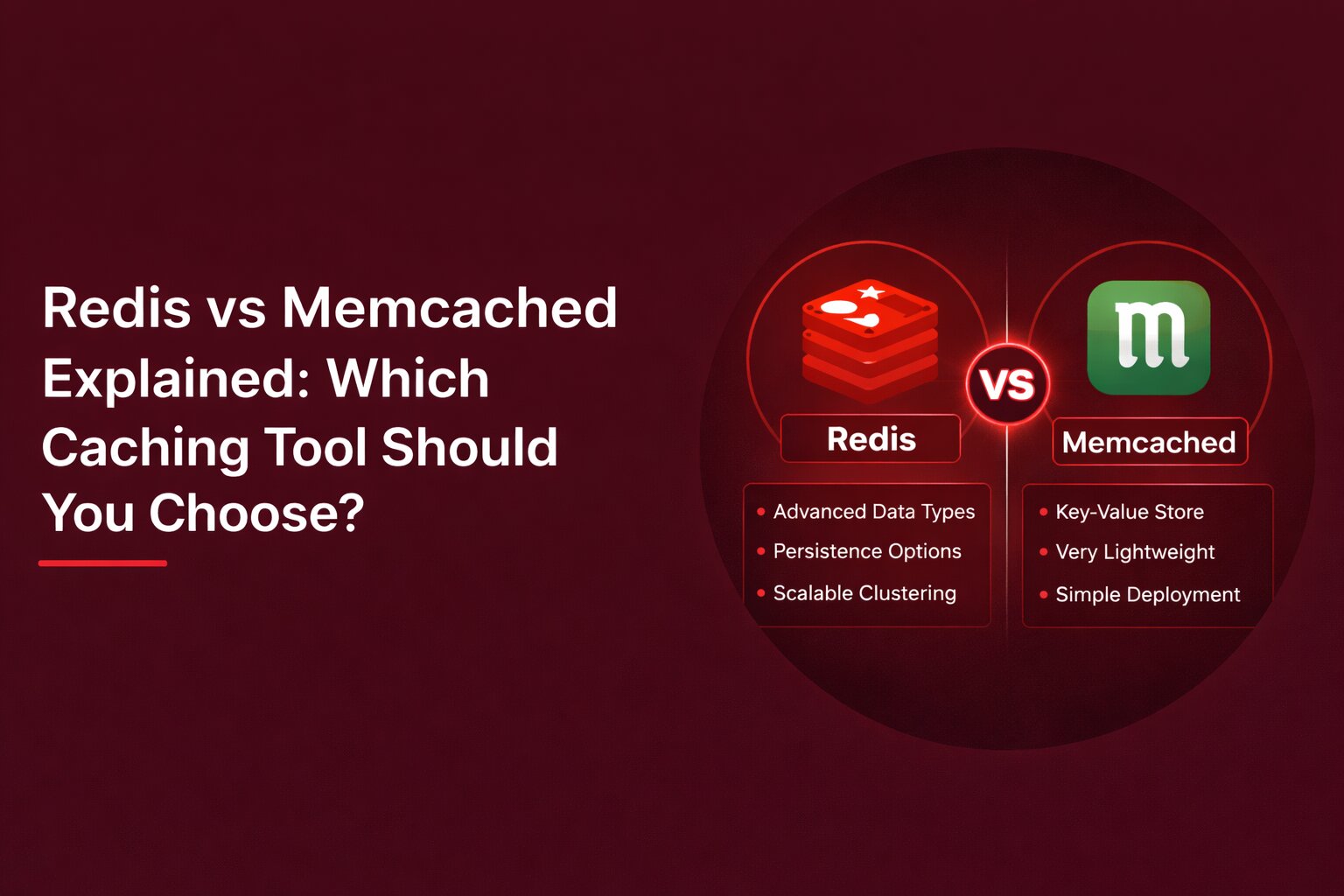
Application speed often determines user satisfaction, conversion rates, and even search rankings. A delay of just a few milliseconds can impact engagement which is why caching has become a core architectural strategy for modern platforms.
If you’ve been evaluating caching technologies, you’ve likely encountered two dominant players: Redis and Memcached. Understanding what is Redis, what is Memcached, and how they differ can help you design a faster, more resilient infrastructure.
This guide breaks down the Redis vs Memcached comparison in practical terms not just features, but when each tool makes the most sense for your business.
What Is Redis?
Redis (Remote Dictionary Server) is an open-source, in-memory data store known for its versatility and performance. While commonly used for caching, it also supports message brokering, real-time analytics, leaderboards, and session storage.
Unlike traditional key-value caches, Redis allows developers to store structured data such as lists, sets, hashes, and sorted sets.
Key Strengths:
- Sub-millisecond latency
- Built-in persistence options
- Replication and high availability
- Advanced data structures
- Lua scripting for server-side logic
Example:
A global eCommerce company uses Redis to maintain real-time inventory visibility during flash sales. Without caching, the database would quickly become a bottleneck under heavy traffic.
What Is Memcached?
Memcached is a high-performance distributed memory caching system designed for simplicity. It stores small chunks of data in memory to reduce database load and accelerate dynamic web applications.
Where Redis emphasizes flexibility, Memcached focuses on doing one job extremely well – fast caching.
Core Advantages:
- Lightweight architecture
- Multi-threaded performance
- Extremely fast read speeds
- Easy deployment
- Minimal configuration
Example:
Content-heavy publishing platforms often use Memcached to cache frequently accessed articles, reducing database queries during traffic spikes.
Redis vs Memcached Comparison at a Glance
When evaluating caching tools, architecture and operational needs matter more than popularity.
| Feature | Redis | Memcached |
| Data Types | Rich structures | Key-value only |
| Persistence | Yes | No |
| Scalability | Supports clustering | Requires manual sharding |
| Performance | Slightly heavier but powerful | Ultra-fast for simple caching |
| Use Cases | Real-time apps, analytics | Basic caching |
This caching tools comparison shows that the decision isn’t about which tool is universally superior – it’s about alignment with your workload.
Also Read – 9 Reasons to Add Redis to Your Data Stack
Redis vs Memcached Differences That Matter
Let’s move beyond surface-level comparisons and focus on architectural impact.
1. Data Handling
Redis behaves more like a data platform than a cache. If your application relies on ranking systems, queues, or counters, Redis offers native capabilities.
Memcached, meanwhile, is ideal for ephemeral data where persistence isn’t required.
2. Persistence and Recovery
Redis can snapshot data or write it to disk, helping systems recover quickly after outages.
Memcached clears data on restart acceptable for non-critical caches but risky for session-heavy applications.
3. Scalability
Redis clusters allow horizontal scaling with built-in partitioning.
Memcached scaling typically requires engineering effort to rebalance nodes.
4. Operational Complexity
Memcached wins on simplicity. Redis demands more planning but rewards teams with broader functionality.
These Redis vs Memcached differences often become decisive at scale.
Also Read – Redis for High-Performance APIs: Caching Patterns You Must Know
Redis vs Memcached Performance: Is One Faster?
Performance debates usually miss an important nuance speed depends on workload.
Memcached can outperform Redis in straightforward read-heavy environments because of its multithreaded design.
However, Redis reduces the need for additional infrastructure by supporting multiple operations within a single engine.
Case Insight:
A fintech startup initially deployed Memcached for transaction caching. As fraud detection rules grew more complex, they migrated to Redis to process real-time scoring without introducing another system.
The lesson? Raw speed matters less than architectural efficiency.
When to Use Redis And Memcached
Choosing correctly early on prevents costly migrations later.
Choose Redis if:
- Your app needs persistence
- You require advanced data structures
- Real-time processing is critical
- High availability is non-negotiable
- You anticipate rapid growth
Choose Memcached if:
- Your caching needs are straightforward
- Data loss isn’t a concern
- You prioritize minimal overhead
- Your team prefers operational simplicity
Understanding when to use Redis vs Memcached ensures your infrastructure supports future demands rather than limiting them.
Redis or Memcached: Which Is Better for Modern Architectures?
Many teams ask directly: Redis vs Memcached – which is better?
For cloud-native and microservices environments, Redis often aligns more naturally with evolving requirements. Its ability to handle caching, streaming, and messaging reduces architectural fragmentation.
Memcached remains valuable for lean deployments where complexity would add unnecessary cost.
Think of it this way:
- Memcached is a precision tool.
- Redis is a multi-functional platform.
Your choice should reflect your application’s trajectory not just its current state.
Operational Considerations Most Teams Overlook
Beyond features, long-term maintainability deserves attention.
Organizations frequently underestimate:
- Capacity planning
- Failover strategies
- Memory optimization
- Security hardening
- Monitoring
As systems grow, many companies turn to Redis Support Services to maintain performance and reliability without overburdening internal teams.
Engaging experts early can prevent latency issues and costly downtime.
Businesses running mission-critical workloads often benefit from End-to-End Redis Support Solutions, ensuring everything from deployment to scaling is handled proactively.
For companies lacking specialized in-house expertise, Redis Consulting & Support Services can accelerate adoption while reducing operational risk.
Conclusion: Making the Smart Caching Decision
Both technologies have earned their place in modern infrastructure. The right choice depends less on hype and more on workload complexity, scalability goals, and resilience requirements.
This Redis vs Memcached comparison highlights a simple reality: Memcached excels at lightweight caching, while Redis supports broader, data-intensive architectures.
If your priority is speed with minimal overhead, Memcached remains a strong contender. But if flexibility, durability, and scalability are on your roadmap, Redis often emerges as the strategic choice.
Still wondering Redis vs Memcached which is better? The answer lies in aligning technology with business outcomes.
Organizations planning for sustained growth increasingly pair the right caching strategy with expert guidance ensuring performance today without compromising tomorrow.
About the Author