Apache NiFi has evolved into one of the most reliable frameworks for data routing, transformation, streaming ingestion, and flow orchestration. Its visual interface, processor-driven architecture, back-pressure handling, and native provenance tracking make it ideal for real-time pipelines. However, the challenge begins when businesses need to scale NiFi to multi-node clusters, integrate it with complex ecosystems, or optimize it for high-throughput workloads.
This brings us to a critical decision. Should you build and maintain NiFi capabilities in-house, or should you work with external NiFi consultants? Below is a technical comparison designed for engineering leaders and architects making strategic decisions.
In-House NiFi Setup
Building an internal NiFi team means hiring NiFi flow developers, cluster administrators, DevOps engineers, and data security professionals. While this offers maximum control, it also requires significant commitment.
Advantages of an In-House Setup
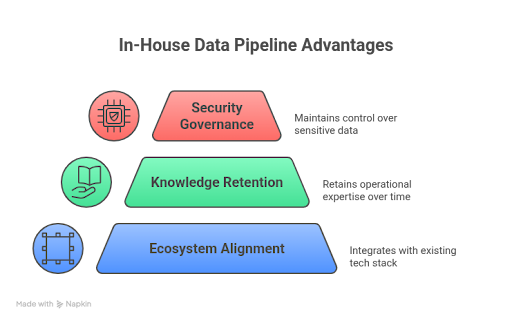
1. Architecture aligned with your internal ecosystem
Internal engineers can build flows that align with the exact stack you already use. For example, suppose your architecture depends on Kafka ingestion, Airflow scheduling, and Iceberg or Delta Lake storage. In that case, an in-house team can tightly integrate NiFi with internal IAM, observability, and security policies.
2. Internal knowledge retention
As your engineers build flows for scenarios such as event-driven ingestion, ETL orchestration, CDC pipelines, or IoT streaming, your organization retains long-term operational knowledge. This helps when you need advanced features such as record-based processing, distributed map cache optimization, or custom routing strategies.
3. Enhanced security governance
Organizations handling sensitive data prefer in-house pipelines because policy management, Kerberos configuration, certificate rotation, and role-based access remain entirely within their perimeter.
Challenges of an In-House Setup
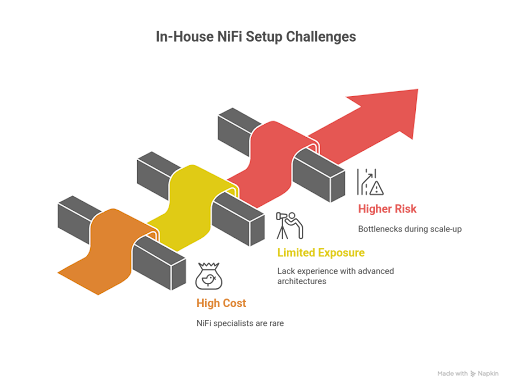
1. High cost and long onboarding
NiFi specialists are rare. An effective team requires:
• Flow engineers
• Cluster administrators
• DevOps support for upgrades and monitoring
• Security engineers for NiFi and Ranger or Knox integration
This slows time-to-deployment and increases cost.
2. Limited exposure to advanced NiFi architectures
Most internal teams do not have experience with scenarios like:
• Stateless NiFi in Kubernetes
• Multi-region load-balanced clusters
• Record-aware pipelines for schema evolution
• Custom processor development in Java
• Zero downtime upgrades
These require hands-on exposure across multiple industry use cases.
3. Higher risk when scaling
Many common issues arise in in-house setups, such as:
• Back-pressure misconfiguration
• Inefficient queue design
• Incorrect partitioning of flows
• Unbalanced node loads
• Poorly designed failure handling
These create bottlenecks during scale-up.
Hiring a NiFi Consultant
An external consultant from an experienced Apache NiFi development company offers a different value proposition. These experts work with NiFi implementations across industries, which gives them deep pattern-based knowledge.
Advantages of Hiring NiFi Consultants
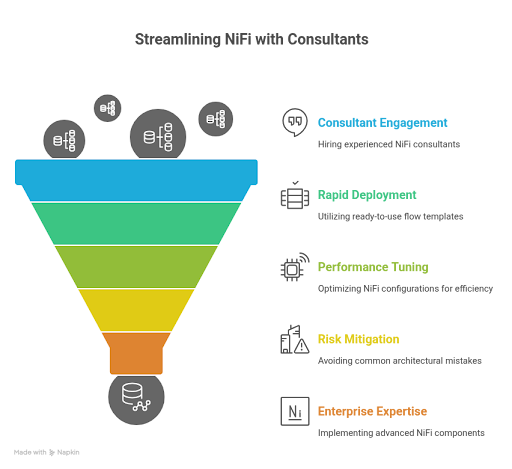
1. Faster time-to-production
Since consultants have ready-to-use flow templates and proven configurations, your data pipelines reach production quickly. For example, a typical ingestion pipeline for logs or IoT data typically includes processors such as ConsumeKafka, ConvertRecord, UpdateAttribute, and PutParquet. A consultant can assemble this in hours, not weeks.
2. Deep knowledge of performance tuning
Consultants know when to switch from JSONTreeReader to RecordReaders, how to tune execution queues, how to split or merge flows effectively, and how to reduce provenance overhead. These optimizations matter when processing millions of events per second.
3. Reduced architectural risk
Experienced teams avoid common mistakes such as:
• Using ExecuteScript for heavy tasks instead of Record processors
• Overloading queues by chaining processors incorrectly
• Creating single-node bottlenecks in multi-node clusters
• Misconfiguring load-balanced connections
This prevents future downtime and maintenance issues.
4. Expertise with enterprise-scale setups
Consultants are familiar with:
• Kubernetes-based containerized NiFi
• Stateless NiFi for near serverless workloads
• CI-CD using NiFi Registry
• NiFi with Ranger for fine-grained access
• Secure S2S communication
• DistributedMapCache tuning
These are highly advanced components rarely mastered by internal teams.
Challenges of Hiring Consultants
1. External dependency
Your pipelines may require periodic consultant involvement unless you request structured documentation and handover.
2. Adaptation to internal culture
Consultants often follow strict best practices, which may require your internal teams to adjust workflows, standards, or deployment processes.
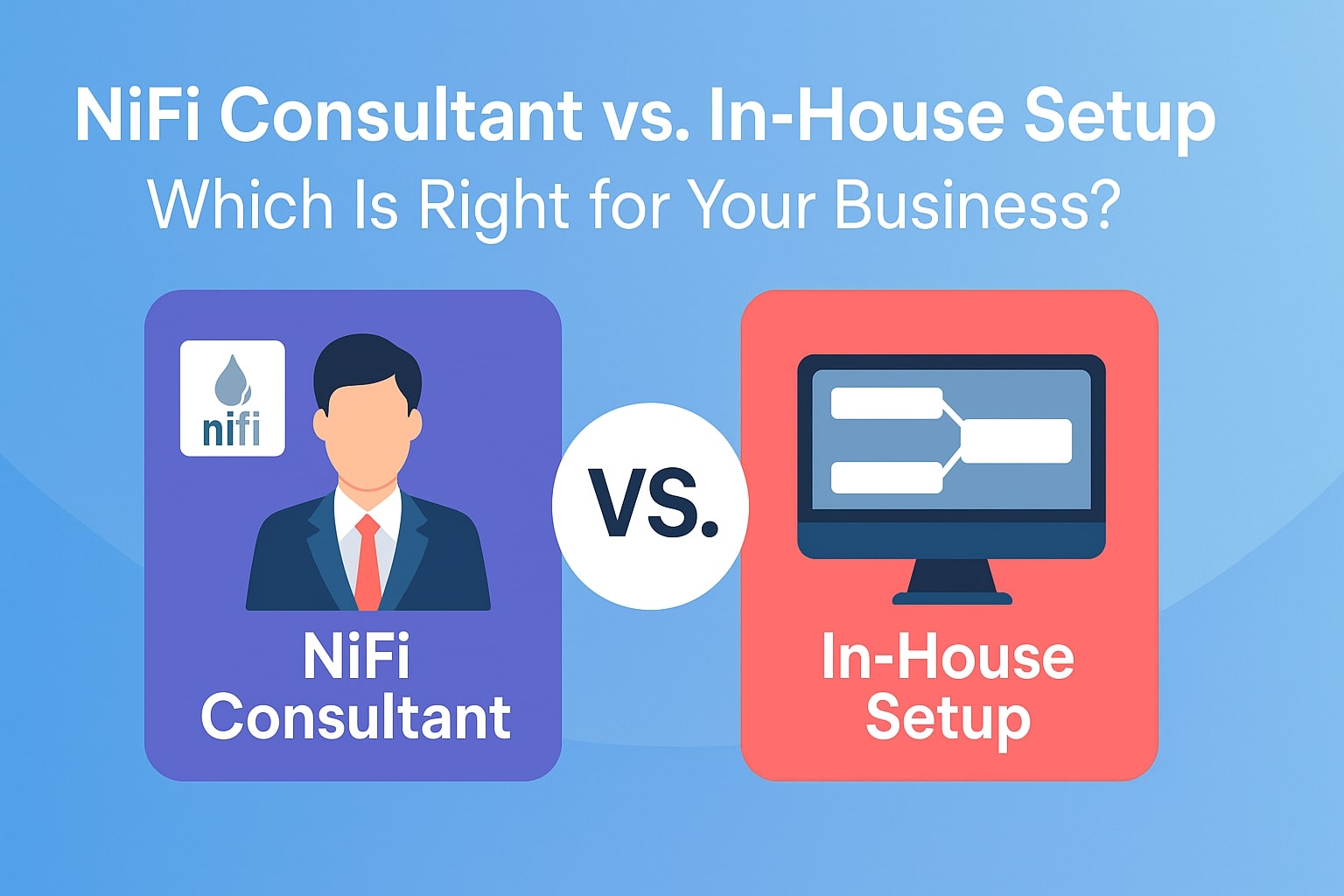
Technical Comparison: NiFi Consultant vs In-House
Below is a visual comparison of NiFi Consultant vs In-House
| Criteria | In-House Team | NiFi Consultant |
| Setup Speed | Slow to moderate | Fast |
| Expertise Depth | Depends on hiring | Very high |
| Cost Model | Fixed salaries | Flexible |
| Complex Use Cases | Often limited | Strong capability |
| Cluster Tuning | Moderate | Expert level |
| Risk | Higher | Lower |
Which Approach Should You Choose
Choose In-House if:
• You need permanent ownership of flows
• You have enterprise engineering maturity
• You can invest in training and retention
Choose Consultants from an Apache NiFi Development Company if:
• You need fast deployment
• Your pipelines are complex or high throughput
• You want proven best practices from day one
• Your internal team lacks cluster or performance experience
Most organizations prefer a hybrid approach where consultants build the core architecture and internal teams maintain it afterward.
Conclusion
Apache NiFi is powerful but requires the right expertise to scale, optimize, and manage at an enterprise level. The choice between an in-house team and external consultants should depend on your data maturity, project complexity, and urgency. While in-house teams provide long-term ownership, consultants offer speed and proven architectural patterns. Evaluating your technical constraints and growth plans will help you adopt the most efficient and future-ready NiFi implementation strategy.
About the Author