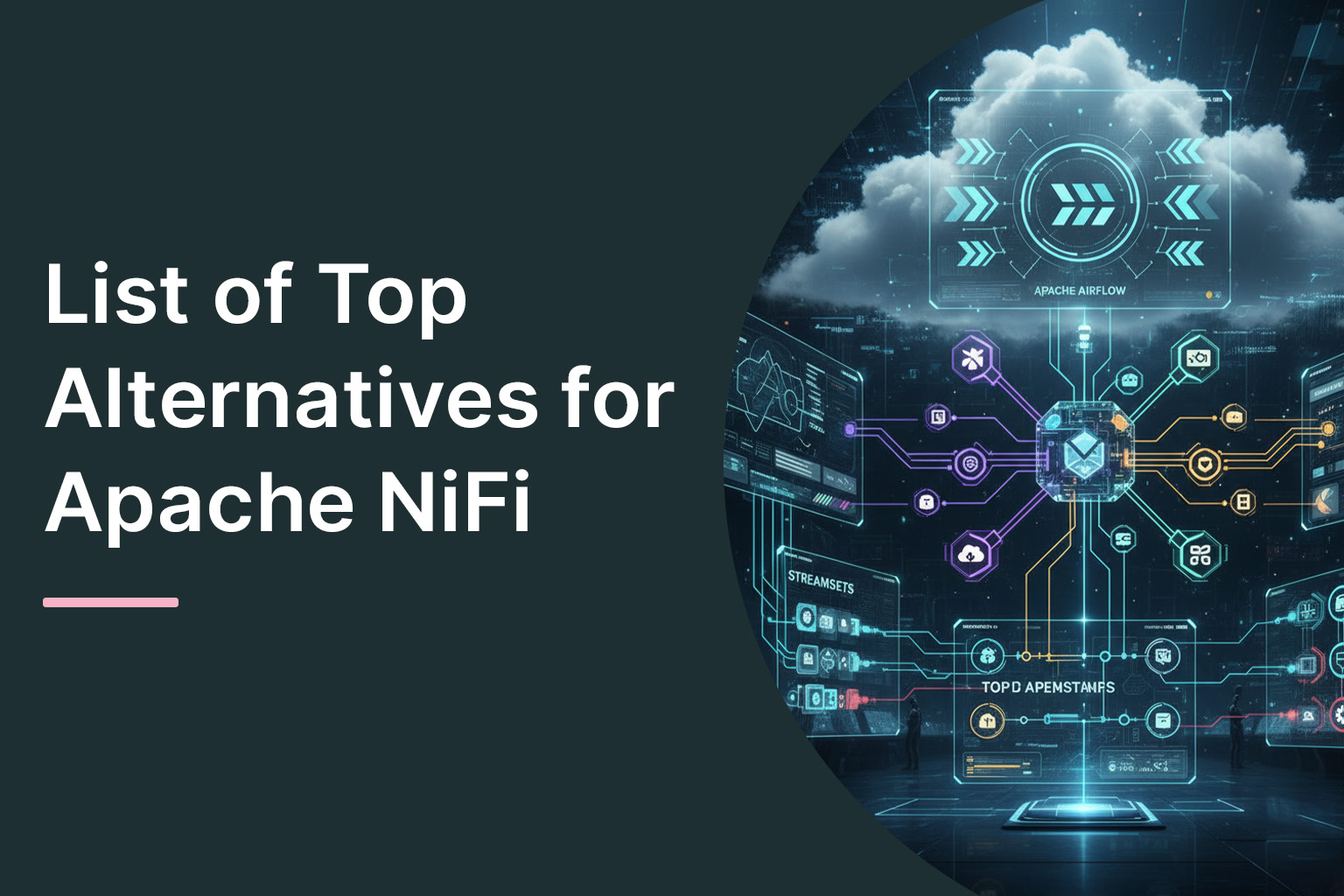
Managing data pipelines is no longer just about moving information from one system to another. Businesses want tools that connect fast, transform cleanly, automate smartly, and scale without breaking. Apache NiFi has earned its place in this space for its strong flow-based design and real-time data movement. But not every team wants or needs the same workflow structure, which is why many organizations look for Apache NiFi alternatives that offer different strengths.
This guide explores five of the best alternatives to Apache NiFi, based on capability, ease of use, automation depth, and enterprise adoption. The goal is to give you a practical and clear comparison so you can choose the right fit for your data environment.
1. Talend
Talend is often one of the first options teams consider when comparing data integration tools like Apache NiFi. It offers both open-source and commercial versions, but its real power shows in Talend Cloud.
Why Teams Choose Talend
Talend combines ETL, ELT, governance, data quality, and application integration in one platform. It works well for teams that want visual workflows and central monitoring.
Key strengths
- Over 1,000 connectors for enterprise data sources
- Built-in data quality and profiling
- Advanced mapping and transformation
- Strong governance with Talend Data Fabric
Practical use case
A retail company used Talend to unify product data from 15 vendors. With Talend’s data cleansing tools, they reduced duplicate entries by nearly 40%.
Why it’s a NiFi competitor
NiFi is strong for flow-based real-time pipelines. Talend is better for deep transformation, scheduled workflows, and multi-cloud integration.
2. Fivetran
Fivetran is known for its “set it and forget it” model. It is a fully managed ELT tool built for automated data extraction from SaaS applications.
Why businesses consider Fivetran
Fivetran removes the maintenance overhead that comes with building connectors manually. It is built for teams that want simple configuration and fast setup.
Key strengths
- Prebuilt connectors that need little or no engineering
- Schema changes update automatically
- Strong warehouse-first architecture
- High reliability for SaaS-to-warehouse pipelines
Case-style example
A fintech company needed to move Salesforce, Stripe, and HubSpot data into Snowflake daily. Fivetran’s automated sync reduced engineering time by 80%.
Why it competes with Apache NiFi
NiFi requires more custom configuration and hands-on flow management. Fivetran excels when teams want zero-pipeline maintenance and quick ELT deployment.
3. Airbyte
Airbyte has quickly become one of the most discussed data pipeline tool alternatives because of its modern open-source approach and fast connector innovation.
Why teams like Airbyte
Its community-driven connector framework allows rapid creation of new connectors. The paid version offers managed pipelines with better scaling.
Key strengths
- Connector development kits for custom sources
- Open-source flexibility
- Strong cost advantage for engineering-centric teams
Case insight
A data engineering team in logistics built a custom ERP connector on Airbyte in less than a week, something that would have taken much longer on older ETL systems.
Why it competes with NiFi
NiFi is deeply visual. Airbyte is code-friendly. Both support real-time syncs, but Airbyte enables faster connector customization and easier deployment on Kubernetes.
4. Informatica
Informatica is one of the oldest names in the data integration ecosystem and remains a top competitor for companies needing advanced governance and enterprise-level ETL.
Why large enterprises choose it
It supports very large-scale data operations with advanced metadata management and security features.
Key strengths
- End-to-end data integration and governance
- AI-assisted mapping through CLAIRE
- Powerful transformation engine
- Multi-cloud and hybrid environment support
Enterprise example
A global insurance company used Informatica to build a standardized data hub. This reduced reporting delays from hours to minutes.
Why it’s a strong Apache NiFi competitor
NiFi provides flexible flow automation, while Informatica is designed for structured enterprise processes, compliance-heavy scenarios, and complex transformations.
5. StreamSets
StreamSets focuses on pipeline resilience. It helps teams build pipelines that adapt to schema changes, performance shifts, and scaling requirements without manual intervention.
Why engineers like StreamSets
It offers version control for pipelines, strong monitoring, and a very intuitive design.
Key strengths
- Smart pipeline engine
- Built for hybrid and multi-cloud environments
- Handling of drift and unpredictable data patterns
- Strong performance at scale
Use case
A telecom company used StreamSets to handle fast-moving logs from thousands of devices. StreamSets managed schema drift automatically, keeping pipelines stable.
Why it is a top alternative
StreamSets and NiFi share visual workflow similarities, but StreamSets provides better pipeline observability and automatic adaptation.
Conclusion: How to Choose the Right Apache NiFi Alternative
When reviewing Top Apache NiFi competitors, the right choice depends on your team’s goals:
- Need enterprise-level governance? Informatica
- Want minimal maintenance? Fivetran
- Prefer open-source and flexibility? Airbyte
- Need deep transformation? Talend
- Want resilient, self-adjusting pipelines? StreamSets
Each tool solves problems in a different way. While NiFi remains powerful for flow-based orchestration, these alternatives bring unique strengths.
If your organization needs help with architecture design or migration planning, working with experts who offer Apache NiFi Development Services can help you build the right data foundation and create a scalable future-proof pipeline strategy.
About the Author